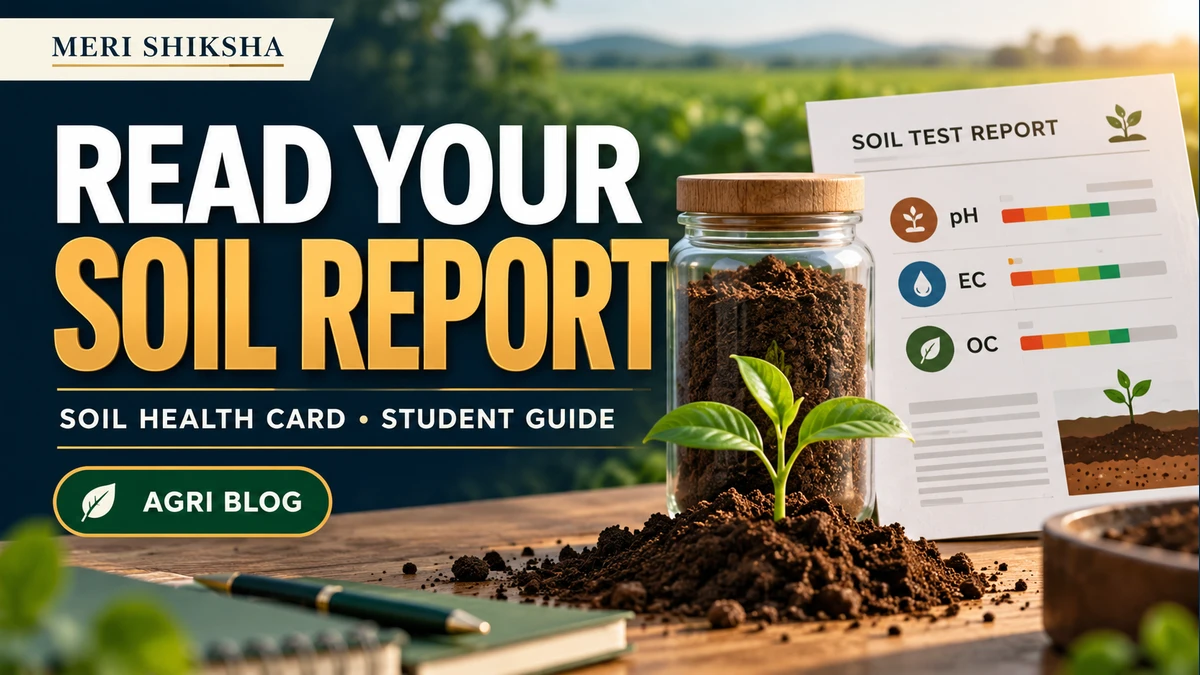
A Soil Health Card becomes useful when you can connect its numbers with the right field, sample and crop. Before asking “which fertiliser should be applied?”, learn to ask “what does this report actually describe?”
Soil-report literacy is particularly relevant during the October–November Khet Bachao awareness campaign. This blog offers a student reading method, rather than a fertiliser prescription. Use it to prepare a discussion with your supervisor or a qualified local adviser.
Start with the sample, not the colour code
Match the report to its field or sample identifier and record the sampling date. Ask whether the person discussing the result knows how and where the sample was collected. If information is missing, put the question in your notes rather than assuming that a nearby field is represented.
For student work, anonymise personal details before sharing the report publicly. Keep only the location detail needed to explain the exercise, with permission.
A useful first sentence is: “I reviewed a report for this identified sample, collected on this recorded date.” If you cannot complete the sentence accurately, explain what remains unknown.
Recognise what the report is measuring
The government's Soil Health Card explainer describes 12 parameters: N, P, K, S, Zn, Fe, Cu, Mn, B, pH, electrical conductivity and organic carbon. The department's education manual explains that the card combines test information with crop-based recommendations.
| Label | What it describes | Question for your discussion |
|---|---|---|
| pH | Soil reaction: acidity or alkalinity. | How should this result be interpreted for the crop and local soil? |
| EC | Electrical conductivity, used in assessing soluble salts. | Which unit and interpretation method does this laboratory use? |
| OC | Organic carbon content. | What does this measurement support, and what additional information is needed? |
Copy the laboratory's labels faithfully. Do not replace an unfamiliar measure with a more familiar one because the names sound similar. Write down the term and ask for clarification.
A test result and a fertiliser dose are different entries
Keep the value, unit and laboratory interpretation together when taking notes. A number without its unit is not a usable comparison. Check whether two reports use the same method and reporting basis before describing a change.
Then read any crop recommendation as a separate part of the document. Identify the named crop, area basis and other stated conditions. Ask an adviser to explain how a recommendation relates to the intended field operation.
Do not convert a colour into a dose yourself. This guide does not prescribe a universal pH range, nutrient threshold or percentage increase in fertiliser. Field-specific advice belongs with the laboratory interpretation and qualified guidance.
Make a one-page report-reading note
- Describe the evidence. Record the sample identifier, date, document source and information you were allowed to use.
- Choose three entries. Copy each value, unit and interpretation accurately.
- Explain the difference between observation and advice. Mark what the laboratory measured and what it recommended.
- List unanswered questions. Include sampling history, intended crop or an unclear unit if relevant.
- Record the discussion. Note what your supervisor clarified and what still needs checking.
If you use a fictional practice card, label every value as an illustration. Do not present invented results as a real farmer's test. For a comparison exercise, explain why the documents are comparable before discussing whether soil conditions improved.
Common questions
Kya ek report neighbouring farm par bhi apply kar sakte hain?
Report kis sample ya field ko represent karti hai, pehle confirm karein. Neighbouring field ke liye same result assume na karein.
Kya nutrient value ko seedha fertiliser quantity maan sakte hain?
Nahi. Test result aur crop recommendation alag entries hain. Units aur recommendation ka basis qualified adviser se samjhein.
Blog padhkar fertiliser dose decide ho jayegi?
Nahi. Yeh report-reading guide hai. Actual field aur crop ke liye laboratory interpretation aur local technical guidance use karein.
Related learning
Keep observations and interpretation separate in your RAWE diary
References and scope
- PIB: Understanding the Soil Health Card — background reference, not a new 2026 scheme announcement.
- Department educational manual: soil testing and Soil Health Card components.
- ICAR: 22 October 2026 campaign context.
Checked 26 October 2026. The reading sequence and exercise are editorial suggestions.
